moving

Welcome to The AIAIASP...........write to us on circlesecretary@gmail.com
Showing posts with label Income Tax. Show all posts

Recovery of Income Tax for the year 2020-21 (Assessment Year 2021-22) – Salient features of the new tax regime (optional) – Self declaration Form


Recovery of Income Tax for the year 2020-21 (Assessment Year 2021-22) – Salient features of the new tax regime (optional) – Self declaration Form

Principal Controller of Defence Accounts (Central Command)
Cariappa Road, Lucknow Cantt.— 226002

No: AN/IV/Pay/IT/2020-21

Dated:66-12-2020

CIRCULAR

Sub:- Recovery of Income Tax for the year 2020-21 (Assessment Year 2021-22)

The Finance Act 2020 had made changes in respect of salaried class as compared to last year with an option for the individual to select tax calculation cither with Savings and standard deduction or to opt for tax calculation without these deductions.

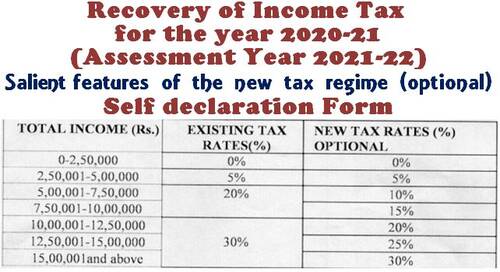
As per Sec.115BAC inserted by Finance Act 2020the tax rates as per new (optional) tax regime Vs old rates is as given in the table below:

TOTAL INCOME (Rs.)EXISTING TAX RATES (%)NEW TAX RATES (%) OPTIONAL
0-2,50,0000%0%
2,50,001-5,00,0005%5%
5,00,001-7,50,00020%10%
7,50,001-10,00,00015%
10,00,001-12,50,00030%20%
12,50,001-15,00,00025%
15,00,001 and above30%

The few salient features of the new tax regime (optional) are mentioned below:

i. At the start of each financial year, the employee willing to opt new tax regime will have to intimate to employer to make TDS in accordance with the provisions of section 115 BAC.
ii. If such intimation is not made TDS will be deducted at old tax regime.
iii. Intimation once made cannot be modified during the year.
iv. The option at the time of filing of return of income could be different from the intimation made by the employee to the employer for that previous year.
v. Various allowances/investments will not be eligible for claiming deduction/ exemption.
vi. The following deductions will have to be foregone for tax calculation under new tax regime.

View: TDS and Tax on Salary Section 192 FY 2020-21 AY 2021-22 – Income Tax Circular No. 20/2020

  • All deductions under Chapter VI-A (except the deduction under Section 80 CCD(2))
  • Deductions under Section 10 (13A)HRA
  • Section 24 (Interest on borrowed capital/income from House property)
  • Standard Deduction, Professional Tax (Under section16).

In this connection, officials intending to opt for new tax regime for the FY 2020-21(AY 2021-22) may furnish the details to this section in the enclosed format. If the intention of deducting TDS in the new tax regime 1s not submitted within the due date it will be presumed that the officials are willing to remain in the old tax regime. Such of those officials who intend to remain in the old tax regime may please intimate on or before 20-12-2020 with relevant proof through proper channel. In absence of same Income [Tax will be deducted from the Pay and allowances of 12/2020 as per calculation of TULIP system.

Savings declared without relevant proof will not be considered for tax benefit.

Jt CDA has seen

Encl: as above

Sd/-
(SIDDARTH KUMAR)
Accounts Officer

Ready Reckoner – Comparison of Income Tax for F.Y. 2020-21 under Existing – New Regime i.r.o. Normal, Senior – Super Senior Citizen

Circulation to:-

All Officer-in-charge

1. All Sections in Main Office

2. All Sub offices under this organization

3. IFA(CC) Lucknow

4. CDA, RTC, Lucknow

5. AO NCC Directorate
6. OA Cell – for uploading on the website of PCDA(CC) Lucknow

Sd/-
Accounts Officer (AN-IV)

SELF DECLARATION

I, Shri /Smt / Kum ………………. Designation…………. Employee A/c NO. …………….. serving in the office of ………….. opt for the Old Tax Module / New Tax Module (Strike out whichever is not applicable) for the FY 2020-2021 (AY 2021-2022).

I may be allowed the following emptions claimed for Old Tax Module on production of relevant documents within 20/12/2020.

Sl. No.Types of SavingsSectionPolicy No.  Folio No. Bank A/c No. /Reference No.Amount for the full Year
1INTEREST ON HOME LOAN24 (b)
2PRINCIPAL OF HOME LOAN80 C
3PUBLIC PUBLIC PROVIDENT FUND80 C
4NSC80 C
5BOND80 C
6MEDICAL PREMIUM80 C
7LIC/PLI80 C
8LIC/PLI80 C
9LIC/PLI80 C
10LIC/PLI80 C
11ELSS80 C
12BANK DEPOSIT UNDER TAX SAVINGS80 C
13SUKANYA SAMRIDDHI80 C
14DONATION80 C
15RENT PAID80 G
16IT EXEMPTION CERTIFICATE (AS APPLICABLE)10 (26)
17OTHERS
18

Note- The option once exercised is final and can not be changed during the current Financial Year.

Signature – ……………
Date – …………………..
recovery-of-income-tax-for-the-year-2020-21-assessment-year-2021-22

Source: Click here to view/download the PDF


Verification of qualifying service under Rule.32 of Pension Rules – Issue of instruction for strict Compliance

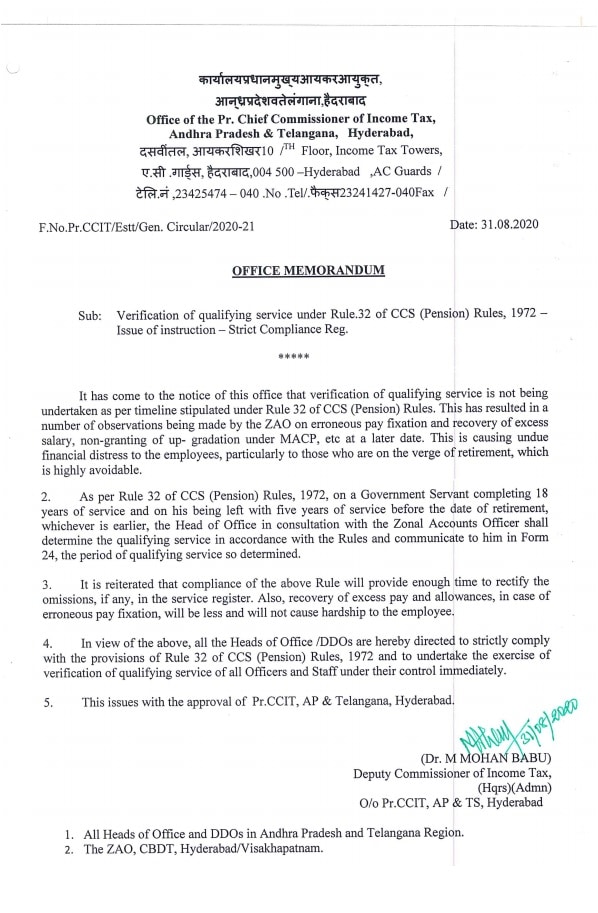
                                           Office of the Pr. Chief Commissioner of Income Tax,

Andhra Pradesh & Telangana, Hyderabad,
10th Floor, Income Tax Towers,
Hyderabad, AC Guards -004500
Tele. 23425474 – 040 /Fax – 423241427-040

F.No.Pr.CCIT/Estt/Gen. Circular/2020-21

Date: 31.08.2020

OFFICE MEMORANDUM

Sub: Verification of qualifying service under Rule.32 of CCS (Pension) Rules, 1972- Issue of instruction — Strict Compliance Reg.

It has come to the notice of this office that verification of qualifying service is not being undertaken as per timeline stipulated under Rule 32 of CCS (Pension) Rules. This has resulted in a number of observations being made by the ZAO on erroneous pay fixation and recovery of excess salary, non-granting of up- gradation under MACP, etc at a later date. This is causing undue financial distress to the employees, particularly to those who are on the verge of retirement, which is highly avoidable.

2. As per Rule 32 of CCS (Pension) Rules, 1972, on a Government Servant completing 18 years of service and on his being left with five years of service before the date of retirement, whichever is earlier, the Head of Office in consultation with the Zonal Accounts Officer shall determine the qualifying service in accordance with the Rules and communicate to him in Form 24, the period of qualifying service so determined.

3. It is reiterated that compliance of the above Rule will provide enough time to rectify the omissions, if any, in the service register. Also, recovery of excess pay and allowances, in case of erroneous pay fixation, will be less and will not cause hardship to the employee.

4, In view of the above, all the Heads of Office /DDOs are hereby directed to strictly comply with the provisions of Rule 32 of CCS (Pension) Rules, 1972 and to undertake the exercise of verification of qualifying service of all Officers and Staff under their control immediately.

5. This issues with the approval of Pr.CCIT, AP & Telangana, Hyderabad.

(Dr. M MOHAN BABU)
Deputy Commissioner of Income Tax,
(Hqrs)(Admn)
O/o Pr.CCIT, AP & TS, Hyderabad

1. All Heads of Office and DDOs in Andhra Pradesh and Telangana Region.
2. The ZAO, CBDT, Hyderabad/Visakhapatnam.

verification-of-qualifying-service-under-rule-32-of-pension-rules-issue-of-instruction-for-strict-compliance

Source: Click Here to view/download the pdf

IT Exemption on Gratuity

IT Exemption on Gratuity – 20 lakhs w.e.f. 29.3.2018
Income tax exemption for gratuity increased from Rs.10 lakhs to 20 lakhs w.e.f. 29.3.2018
Ministry of Finance has enhanced the income tax exemption for gratuity under section 10 (10) (iii) of the Income Tax Act, 1961 to Rs. 20 lakhs. Shri Santosh Kumar Gangwar, Minister of State for Labour and Employment has expressed hope that this would benefit those employees of PSUs and other employees not covered by Payment of Gratuity Act, 1972 and has thanked the Finance Minister for enhancing the exemption limit.
The ceiling of Gratuity amount under the Payment of Gratuity Act, 1972 has been raised from time to time keeping in view over-all economic condition and employers capacity to pay and the salaries of the employees, which have been increased in private sector and in PSUs.
The latest such enhancement of ceiling of gratuity was made vide Government of India Notification dated 29.03.2018 under which the gratuity amount ceiling has been increased from Rs.10 lakhs to 20 lakhs w.e.f. 29.3.2018.
PIB

Last Date for Filing of Annual Return in GST for the year 2017-18 extended up to 30th June, 2019

Press Information Bureau
Government of India
Ministry of Finance
07 MAR 2019 8:31PM by PIB Delhi
Last Date for Filing of Annual Return in GST for the year 2017-18 extended up to 30th June, 2019
The GST law mandates filing of annual return in FORM GSTR -9 and FORM GSTR-9A. Vide Order No 3/2018-Central Tax, dated 31.12.18, the last date for filing the Annual Return for the Financial Year 2017-18 has been extended to 30th June 2019.
      It is being informed to the trade and industry that the form is now available on the common portal for filing and taxpayers are requested to file their returns at the earliest.
     Taxpayers may please exercise caution while filing this return as facility to revise the FORM GSTR -9 and FORM GSTR-9A is not available. 
*****

Income Tax Department Does Not Want People To Do These Five Transactions

In a bid to implement the government’s mission to make India a cashless or less cash country and weed out corruption, the Income Tax Department has again warned people to refrain from large cash transactions, contravention of which may result in the levy of penalty or disallowance of tax deductions.


Following are the five transactions that Income Tax Department doesn’t want you to do.

1. Don’t accept cash of Rs 2,00,000 or more in aggregate from a single person in a day or for one or more transactions relating to one event or occasion. Instead of cash, you are advised to use an account payee cheque or account payee bank draft or use of electronic clearing system through a bank account for such transactions. However, the said restriction shall not apply to government, any banking company, post office savings bank, co-operative bank or a person notified by the Central Government. Section 271DA of the Income Tax Act provides for levy of penalty on a person who receives a sum in contravention of the provisions of section 269ST. The penalty shall be equal to the amount of such receipt. However, the penalty shall not be levied if the person proves that there were good and sufficient reasons for such contravention.

2. Don’t receive or repay specified sum exceeding Rs 20,000 or more in cash for transfer of immovable property and use account payee cheque or account payee demand draft or use of electricity clearing system through a bank account. “Specified sum” means any sum of money receivable, whether as advance or otherwise, in relation to transfer of an immovable property, whether or not the transfer takes place. Contravention of the provisions of section 269 SS will attract penalty under section 271 D. Penalty under section 271 D shall be levied of an amount equal to loan or deposit taken or accepted.

3. Don’t pay more than Rs 10,000 in cash relating to expenditure of business/ profession. If such expenses exceeding Rs 10,000 are made in any mode, other than by an account payee cheque drawn on a bank, or account payee bank draft, or use of electronic clearing system through a bank account, no deduction shall be allowed in respect of such expenditure in the profit and loss account.

4. Don’t donate in excess of Rs 2,000 in cash to a registered trust or political party. Not only you won’t be able to claim deductions under section 80G of the Income Tax Act for such donations, but appropriate actions would be initiated against the trust or political party for encouraging money laundering.

5. Don’t pay health insurance premiums in cash. If you make any payment in cash on account of premium on health insurance facilities, you won’t get deductions under Section 80D of the Income Tax Act.

So, it is advisable for your own good not to violate the above rules, as the Income Tax Department is seeking information regarding such violations, black money or benami transactions.


CBDT – extension in due date for non-tax audit cases is fake and there are no such plans to extend this deadline beyond 31st July, 2018


CIRCULAR No.4/2018

F.No.370889/25/2018
Government of India
Ministry of Finance
Department of Revenue
Central Board of Direct Taxes

New Delhi, Dated 21st July, 2018

This Circular is issued in pursuant to 139(1) of the Tax Act, 1961 is to clarify that rumors spreading across in media regarding extension in due date for non-tax audit is fake and no such plans to extend this deadline beyond 31st July, 2018. The department already received over 1 crore returns filed electronically.

As per Section 234F of the Income Tax Act, from 1st April 2018, the penalty for late filing income tax return would be as

(a) five thousand rupees, if the return is furnished on or the 31st day of December of the assessment year;

(b) ten thousand rupees in any other case:

Provided further that if the total income of the person not exceed five lakh rupees, the fee payable under this section shall not exceed one thousand rupees. Therefore, the assessees are hereby asked to file their ITRs before the due date to avoid the penalty.

(Sanyam Suresh Joshi)

DCIT, CBDT

Source: Confederation

Late fee on delay in filing of Income Tax Return for 2017-2018 (Asst. Yr : 2018-19)


LATE FEE ON DELAY IN FILING INCOME TAX RETURN FOR THE YEAR ENDED 31ST MARCH, 2018 (Asst.Yr: 2018-19) under sec. 234F:

1. If Return filed during 01/04/2018 – 31/07/2018 : Late Fee NIL

2. If Return filed during 01/08/2018 – 31/12/2018 : Late fee Rs. 5000

If total income does not exceed Rs.5 Lakhs then this Late fee will be restricted to Rs. 1000

3. If Return filed during 01/01/2019 – 31/03/2019 : Late Fee Rs. 10000

If total income does not exceed Rs.5 Lakhs then this Late Fee will be restricted to Rs. 1000 only.

Better Get your ITR filed by 31/07/2018

Budget2018 – Idea Worth Rs 25,000 Crore: Tax The Rich Farmer


When the government is hard-pressed to raise income-tax collection by bringing more people in the tax net and discouraging tax evasion, one area where it can reap a quick dividend is agricultural income.
And that too without burdening the small and marginal farmers. All farmers are not poor. Agriculture hides a diversity of land-holding and income. According to the National Sample Survey, 70% of agricultural households in India have marginal holdings (under 1 hectare), and only 0.4% hold over 10 hectares.
The proportion of agricultural households holding 4-10 hectares of land is 3.7%. By taxing the incomes of the top 4.1% of agricultural households, at an average of 30%, as much as Rs 25,000 crore could be collected as agricultural tax, according to Rajul Awasthi, Global Tax Team Lead at the World Bank.
Last year, Chief Economic Advisor Arvind Subramanian too made a case for taxing the rich farmers. “Why is it that it is very difficult to make a distinction between a poor farmer and a rich farmer-…When you say farmer, people think that you are going after the poor farmer. So what is it about political discourse that does not allow these distinctions to be made. Why can’t we say, rich regardless of where they get their income, should be taxed,” said Subramanian.
Niti Aayog, the government’s thinktank, too proposed a tax on agricultural income in its draft three-year action plan last year. Farm income could be assessed for tax as a three-year average, at a press briefing on Tuesday, making a case for widening the taxpayer base, it said.
Niti Aayog member Bibek Debroy too had said that agricultural income should be taxed at the same threshold as personal income.
However, Finance Minister Jaitley had denied that any plan was in the offing to tax agricultural income. He tweeted: “I categorically state that the Central Government has no plan to impose any tax on agriculture income. As per the Constitutional Allocation of Powers, the Central Govt has no jurisdiction to impose tax on agricultural income.”
But Subramanian had said nothing could prevent state governments from taxing agriculture income. “The constitutional restriction is on central government taxing agriculture income. There too, one could make a case that this is a choice open to 29 state governments and if there are willing takers,” he said, adding there was a need to make a clear distinction between poor and rich farmer.
However, the government has already taken note of agricultural income of non-agriculturists being used as a way to evade tax. In December 2016, then state finance minister Santosh Gangwar had revealed in Parliament that the government was verifying if taxpayers who reported farm income of over Rs 1 crore in nine years to March 2016 were genuine.
Income tax department has found an effective way to find out such tax evaders. The department accesses satellite imagery from Indian Space Research Organisation (ISRO) of the piece of land for specific time periods and if there are no standing crops in that period, it is proved that the assessee is trying to avoid taxes.
Since the government is already working to stop tax evasion through agriculture, will it also move to bring rich farmers in the tax net? Though it is a matter for the states to decide, it can make a beginning by suggesting states to consider such a tax.

Over 11 Lakh PANs Deactivated Or Removed. How To Find Out If Yours PAN Is Active


It is paramount to check your PAN status and link the same with the biometrics-based identity number Aadhaar before the deadline set by government, say financial planners.

 Are you aware that more than 11 lakh PANs or Permanent Account Numbers have been either deleted or deactivated? As per rules, it is illegal for an individual to keep multiple PANs. Also, August 31, 2017 is the last date for linking Aadhaar with PAN. Explaining the rationale behind this, the government said: "The uniqueness of PAN is achieved by conducting a de-duplication check on all already existing allotted PAN against the data furnished by new applicant. Under the existing system of PAN, only demographic data is captured."

It also mentioned, from its Digital India account on microblogging site Twitter, that multiple PANs have been allotted to one person and one PAN allotted to multiple persons.

It is paramount to check the status of your PAN and link it with the biometrics-based identity number Aadhaar before the deadline set by government, say financial planners.


Here's How you can check whether your PAN is active:

Go to the Income Tax Department's e-filing website - incometaxindiaefiling.gov.in.


Spot and click on the 'Know Your Pan' option on the left side panel.

On the next page, fill up your details carefully. You need to enter details such as name, status (individual, Hindu Undivided Family etc.), date of birth and phone number.

Be careful while entering your details on the Income Tax E-Filing website and double-checking is advisable, say financial planners.

Click submit.

On the next page, enter the OTP or one-time password received on your registered mobile number and hit 'Validate'.

"There are multiple records for this query. Please provide additional information," a notification appears on the Income Tax E-Filing website in at least some cases.

Fill in the required details again and click 'Submit'.

On the next page, if the PAN number is not duplicated it will be indicated as 'Active' under the 'Remarks' column.


The Digital India Project is a government initiative, aimed at connecting all Gram Panchayats by broadband internet, promoting e-governance and transforming the country into a connected knowledge economy.


Source : http://www.ndtv.com/

Get ready to file your ITR: Deadline for employers to provide Form 16 is May 31

The time has come for your employer to inform you about the taxes deducted in the previous year i.e. for the financial year 2016-17. Each month, the employer would have deducted tax at source (TDS) on your salary income and deposited the same to the government. 

The income tax Act mandates everyone who deducts TDS to issue a certificate to the individual. Under section 203 of the Income-tax Act, 1961, the employer is mandated to issue Form 16 to the employees showing the total TDS on income. 

And this should happen before the end of this month. Archit Gupta, founder & CEO ClearTax.com informs, "The last date for the employers to share the form 16 with the employees is 31st May of the financial year immediately following the financial year in which income tax was paid and tax deducted." However, in case there is no TDS deducted, the employer need not issue the TDS certificate in Form 16. 


Budget 2016 gave few extension in TDS submissions. "The due dates were extended for submission of TDS Returns. But no extension has been announced for Form 16 yet. It must be kept in mind that an extension in the deadline for employers to provide Form 16 will reduce the time available for filing of returns for the salaried who rely on Form 16 to prepare their returns", says Gupta. 

Penalty for employer 

It is compulsory for the employer to furnish Form 16 to the employee, whether it is the present or any previous employer. "Under section 203 of the Income Tax act, 1961 read with rule 31 of the income tax rules 1962, it is mandatory to furnish." But, what if the employer fails to do so? "Under section 272A (2) (g) of the Income Tax act, the employer is liable to pay the penalty," says Gupta. 

In case the employer has not provided the Form 16 to the employee by May 31 and delays it, there are penalties in place too. Gupta says, "If the employer fails to furnish the form 16 within the due date, he is liable to pay a penalty of Rs.100 per day of default till he issues the form. However, the penalty will not exceed the amount of tax deductible." 

What to do if not received 

At times employees find it difficult to collect the Form 16 from previous employers and sometimes even from the present ones. "The only remedy in case employer refuse to issues Form 16 is to complain to the concerned assessing officer in writing, who will take appropriate action or initiate penalty proceedings against the employer. The employee, however, has no other legal remedy against his employer in case he refuses to issue the certificate except to intimate about such default to the concerned assessing officer, who may take appropriate action or initiate penalty proceedings against the employer." 

What all is there in Form 16 

Form 16 is a summary of the total amount paid to the employee and the TDS on it. 

There are two parts in Form 16- Part A and Part B. While the basic information of the employer and employee, like name, address, PAN and TAN details, period of employment with the employer, summary details of TDS deducted and deposited with the government are captured in Part A, while Part B includes Income chargeable under the head 'Salaries', any other income reported by employee, the various deductions under Chapter VI-A such as section 80C, Section 80D etc. 

Lastly, it will carry the figures for total income (earned during the previous year) and the tax applicable to it. "Part A must be generated and downloaded through Traces Portal. Part A of Form 16 also has a unique TDS Certificate Number. Part B is prepared by the employer manually and issued along with Part A," says Gupta. 

Conclusion 

In addition to the salary income, an employee may have other income too. Once you have received the Form 16 but had not declared any other income to the employer( and therefore no TDS was deducted on it), you may show it while filing the income tax return, the last date for which currently stands at 31st July. 


Source : The Economic Times