moving

Welcome to The AIAIASP...........write to us on circlesecretary@gmail.com
Showing posts with label bonus. Show all posts

Report on New Series of Consumer Price Index for Industrial Workers (CPI-IW) (Base 2016 = 100)

 Report on New Series of Consumer Price Index for Industrial Workers (CPI-IW) (Base 2016 = 100)

Government of India
Ministry of Labour & Employment
Labour Bureau

It is indeed a pleasure to learn that the Report on “New Series of Consumer PriceIndex forIndustrial Workers (Base 2016=100)” has been prepared by Labour Bureau with respect to of the new series of Consumer PriceIndex,Industrial Workers CPI-(IW) with base 2016=100. This report provides a comprehensive detail of key concepts, definitions and methodology used in the revision of CPI-IW base year from 2001 to 2016.

CPI-IW is a vital economic indicator which measures the change in prices of goods and services consumed by the index population. This index is also of high significance to the Government for it is used for regulation and determination of Dearness Allowance (DA) being paid to millions of Central/State Government employees and also to the workers in the industrial sectors besides fixation and revision of minimum wages in scheduled employments. Labour Bureau compiles the indices as per international best practices & guidelines of ILO. The dissemination of CPI­IW is also Special Data Dissemination Standard (SODS) compliant.

One of the most important mandate of the Labour Bureau, an attached office of Ministry of Labour and Employment. is base updation of the prominent economic indicator i.e. Consumer Price Index for Industrial Workers (CPl-IW). The details included in the Report “New Series of Consumer Price Index for Industrial Workers (Base 2016=100)” are expected to bring out inter-alia harmonisation in concepts, definition, methodology of compilation of data/information on CPl-IW. The adoption of the methodologies’ suggested in this Report can go a long way in facilitating the data aggregation and data comparison, both at inter-regional and intra-regional levels besides international comparisons.

It gives me immense pleasure to unveil this report on the occasion of formal release of new series of CPl-IW by the Hon’ble Minster of State (Independent Charge) Labour & Employment with base year 2016 which would replace the current base which was done 19 year back in the year 2001.

Table of Content

ChapterContent
Chapter-I

INTRODUCTION

Chapter-II

SELECTION OF CENTRES, SAMPLE DESIGN & SAMPLE SIZE

Chapter-III

WEIGHTING DIAGRAMS AND PRICE COLLECTION MECHANISM

Chapter-IV

INDEX COMPILATION METHODOLOGY

Chapter-V

CONSUMER PRICE INDEX FOR INDUSTRIAL WORKERS (2016=100)

Annexure-I

LIST OF SELECTED CENTRES UNDER NEW SERIES OF CONSUMER PRICE INDEX FOR INDUSTRIAL WORKERS BASE 2016=100

Annexure- 11

CENTRE WISE SAMPLE SIZE OF WCFI&ES

Annexure-III

SCHEDULE ‘A’ OF WCFI&ES

Annexure-IV

SCHEDULE ‘Bl’ OF WCFI&ES

Annexure-V

CENTRE-WISE GROUP WEIGHTS OF NEW SERIES OF CONSUMER PRICE INDEX FOR INDUSTRIAL WORKERS ON BASE 2016=100 VIS- A-VIS 2001=100

Annexure-VI

CENTRE-WISE LIST OF MARKETS UNDER NEW SERIES OF CPI-IW (2016=100)

Annexure-VII

CENTRE WEIGHTS IN ALL INDIA CPI-IW NEW SERIES (2016= 100)

Annexure-VIII

LIST OF 78 SELECTED CENTRES UNDER OLD SERIES OF CONSUMER PRICE INDEX FOR INDUSTRIAL WORKERS 2001=100

Annexure-IX

CENTRE-WISE LINKING FACTOR

  Annexure-X

  COMPOSITION OF TECHNICAL COMMITIEES/ BODIES

    Chapter I – INTRODUCTION

  Background:   The history of compilation & maintenance of Consumer Price Index Numbers for industrial Workers owes its origin to the deteriorating economic condition of the workers on account of abnormal rise in prices following the First World War. As a result of sharp rise in prices and the cost of living, some Provincial Governments started conducting Family Budget Enquiries and compilation of Consumer Price Index Numbers for Industrial Workers in the country. But none of them was entirely satisfactory. In pursuance of the recommendations made by the Rau Court of Enquiry, the job of compilation & maintenance of Consumer Price Index Numbers for Industrial Workers was taken over by the Central Govt. in 1941. However, the compilation of index numbers on uniform and scientific lines was started only after the conduct of the Family Living Surveys by the Labour Bureau during 1958-59 at 50 important industrial centres, spread over length and breadth of the country, under the guidance of the Technical Advisory Committee on Cost of Living Index Numbers and compilation of Consumer Price Index Numbers for Industrial Workers on base 1960=100. Since then the compilation and maintenance of Consumer Price Index Numbers for Industrial Workers are being done by the Labour Bureau on a continuous basis. The series ( 1982= 100) had replaced the old ( 1960= 100) series with the release of October, 1988 index. Thereafter, the ongoing series on base 2001=100 has replaced the earlier (1982=100) series in 2006.

Index numbers in statistics are indicators of changes in certain economic, social and related phenomena. Most of the current indices are indicators of changes over time in respect of economic characteristics like prices, output, wages, etc. These are termed as price index, production   index, wages index, etc. Price indexis ameasure of how prices change over a period of time, or in other words, it is a way to measure inflation.

In India broadly two price indices are compiled viz. Wholesale Price Index (WPI) and Consumer Price Index (CPI). The first one captures the price situation in wholesale market and second, measure price changes in retail market. Based on the target group, the CPI is further classified as CPI for Industrial Workers, Agricultural Labourers, Rural Labourers, CPI for Rural, Urban, Combined. The present document deals with the Consumer Price Index for Industrial Workers (CPI-IW), one of the prominent economic indicators, which measures the relative changes in retail prices over a period of time in respect of a fixed set of goods and services consumed by an average working class family in a given area with reference to a base year. The changes in consumer prices affect the real purchasing power of households’ money incomes and hence, the standard of living or welfare that they can achieve out of a given money income/ expenditure.

  Labour Bureau an attached office of Ministry of Labour and Employment, since its inception has, inter-alia, been entrusted with the responsibility of compilation, maintenance and disseminating of the CPI­ IW.The CPI-IW is compiled as per international best practices & guidelines of ILO and dissemination of CPI-IW is Special Data Dissemination Standard (SDDS) compliant. It is released on last working day of subsequent month. The CPI-IW is mainly used for regulating and determination of dearness allowance (DA) being paid to large number of Central/ State Government employees and also to the workers in the industrial sectors besides fixation and revision of minimum wages in scheduled employments, hence, having significant financial implications to the Public Exchequer. Further, CPI numbers are widely used as macroeconomic indicator of inflation, and also as a tool by government and central banks for targeting inflation and monitoring price stability. CPI is also used as deflators in the National Accounts. Therefore, CPI is considered as one of the most important economic indicators.

Compilation of Consumer Price Index (CPI) Numbers in India:

  • CPI for Industrial Workers (CPI-IW) with current base 2001= 100
  • CPI for Agricultural Labourers (CPI-AL) / CPI for Rural Labourers (CPI­ RL)with current base 1986-87= 100
  • CPI for Rural, Urban and Combined (CPI-U / R/ C) with current base 2012= 100

  The first two indices are compiled and released by the Labour Bureau, Ministry of Labour and Employment and are specific to population segments. The third is released by the MOSPI. The MOSPI started releasing comprehensive CPis on base 2010=100 for all-India and States/ UTs basis separately for Rural, Urban and combining them to arrive at one CPI (Combined) every month with effect from January, 2011. It revised the base year of the CPI from 2010=100 to 2012=100, incorporating many methodological improvements in consonance with the international practices.

Index Review Committees (IRC) set up by Government:

The Government of India has constituted Expert Committees/ IRCs from time to time to review and report on various aspects of the CPI-IW including the methodology for deriving the weighting diagram, issues relating to conduct of Working Class Family Income & Expenditure Surveys (WCFI&ES), methods of compilation and linking factor, to study and report on the existing price collection procedures and machinery of price collection to make extensive evaluation of the indices and illuminate on improved practices to incorporate while updating the base. Following are the committees set up for CPI-IW:

  • N ilakanthaRath Committee in 1977 to examine 1960 based series of index numbers.
  • K. C. Seal Committee in 1980 to examine the details of the proposed family living survey ( 1981-82) for industrial workers and compilation of new series based on the results of the survey.
  • G . K . Chadha Committee in 2006 to advice Government on matters relating to issues pertaining to Consumer Price Index Numbers for Industrial Workers (CPI-IW) with base year 2001=100.

Major Recommendations of IRC (2006)

  • Base year updation at a gap not exceeding 10 years
  • Consultations with stakeholders from very beginning till the end of survey
  • Standing Tripartite Committee (STC) to be constituted of all the stakeholders like Trade Unions’, Employers Organisations’, Central/State Government Departments, Women’s Organisations and representatives from the newly emerging sectors
  • Coverage of sectors be extended beyond existing seven sectors
  • Number of centers to be reviewed and new upcoming centers to be added

  Base revision of CPI -IW from 2001=100 to 2016= 100

The ongoing series of CPI-IW is with base year 2001=100 covering 78 centres spread across the country. To capture the latest consumption pattern of working class family, the Labour Bureau had undertaken the base revision exercise of CPI-IW with base 2016=100.

The new series of CPI-IW intends to update the base year of the existing series of CPI-IW (2001=100) to the base 2016=100. The main objective of the exercise is to bring out the new series of All-India and individual centre wise Consumer Price Indices for Industrial Workers based on the latest consumption pattern of the working class population.

The consumption pattern of the working class population has undergone change over a period of time and therefore, it becomes necessary that the consumption basket is updated from time to time to account for these changes and thus to maintain the representative character of the index. The need for frequent revision of base on account of fast changing consumption pattern of the target group has been recommended by various National and International level agencies like International Labour Organization, National Statistical Commission, National Commission on Labour and Technical Advisory Committee on Statistics of Prices and Cost of Living (TAC on SPCL). This recommendation was strongly reiterated by the Index Review Committee (IRC) set up under the Chairmanship of Prof. G.K. Chadha, who was a member of Prime Minister’s Economic Advisory Council, which inter­ alia stated that the intervening gap between the two series should not exceed 10 years. Labour Bureau accordingly, has initiated the process to revise the base year of the existing CPI-IW series 2001=100 to a more recent base year 2016=100. The major recommendations of this committee have been considered and incorporated in the base revision of CPI-IW (new series).

The various technical issues like coverage of sectors, selection of centres, fixation of sample size, reference period, conduct of working class family income &expenditure survey, etc., involved in the work of base updation have been discussed at length and decided by the technical bodies. The National Sample Survey Office conducted the field work for collecting the income and expenditure data from the 88 selected centres on the behalf of Labour Bureau from January 2016 to December 2016. Subsequently, the data collected under working class family income and expenditure survey was tabulated by National Institute of Electronics and Information Technology (NIELIT). Besides, the pilot survey for organizing the work for collection of retail prices through the officials of the Labour Commissioner’s Office/ Directorate of Economics and Statistics on a part time basis was done by Labour Bureau and the price quotations are being collected and processed on a regular basis. On the basis of the results revealed by working class family income and expenditure survey (WCFI&ES), the weighting diagrams (average consumption pattern) have been derived in respect of all 88 selected centres. Using the prices pertaining to calendar year 2016 as the base prices, the indices are being compiled through the software developed by NIELIT.

report-on-new-series-of-consumer-price-index-for-industrial-workers-cpi-iw-base-2016-100

Click here to read/ download the full pdf

Productivity Linked Bonus to Railway employees equiv 78 (Seventy Eight) days for the financial year 2019-20: Railway Board Order RBE No. 91/2020

 Grant of Non-Productivity Linked Bonus (ad-hoc bonus) to Central Government Employees for the year 2019-20: Fin Min OM

No.7/24/2007/E III(A)
Government of India
Ministry of Finance
Department of Expenditure
( E Ill-A Branch )
*****

North Block, New Delhi
21st October 2020

OFFICE MEMORANDUM

Subject: Grant of Non-Productivity Linked Bonus (ad-hoc bonus) to Central Government Employees for the year 2019-20.

*****

The undersigned is directed to convey the sanction of the President to the grant of Non-Productivity Linked Bonus (Ad-hoc Bonus) equivalent to 30 days emoluments for the accounting year 2019-20 to the Central Government employees in Group ‘C’ and all non-gazetted employees in Group ‘B’, who are not covered by any Productivity Linked Bonus Scheme. The calculation ceiling for payment of ad-hoc Bonus under these orders shall be monthly emoluments of Rs. 7000/-, as revised w.e.f 01/04/2014 vide OM No.7/4/2014-E.III(A), dated 29th August, 2016. The payment of ad-hoc Bonus under these orders will also be admissible to the eligible employees of Central Para Military Forces and Armed Forces. The orders will be deemed to be extended to the employees of Union Territory Administration which follow the Central Government pattern of emoluments and are not covered by any other bonus or ex-gratia scheme.

2. The benefit will be admissible subject to the following terms and conditions:-

(i) Only those employees who were in service as on 31.3.2020 and have rendered at least six months of continuous service during the year 2019-20 will be eligible for payment under these orders. Pro-rata payment will be admissible to the eligible employees for period of continuous service during the year from six months to a full year, the eligibility period being taken in terms of number of months of service (rounded off to the nearest number of months);

(ii) The quantum of Non-PLB (ad-hoc bonus) will be worked out on the basis of average emoluments/calculation ceiling whichever is lower. To calculate Non-PLB (Ad-hoc bonus) for one day, the average emoluments in a year will be divided by 30.4 (average number of days in a month). This will, thereafter, be multiplied by the number of days of bonus granted. To illustrate, taking the calculation ceiling of monthly emoluments of Rs. 7000 (where actual average emoluments exceed .Rs. 7000/-, Non-PLB (Ad-hoc Bonus) for thirty days would work out to Rs. 7000×30/30.4=Rs.6907.89 (rounded off to Rs.6908/-).

(iii) The casual labour who have worked in offices following a 6 days week for at least 240 days for each year for 3 years or more (206 days in each year for 3 years or more in the case of offices observing 5 day week), will be eligible for this Non-PLB (Ad-hoc Bonus) Payment. The amount of Non-PLB (ad-hoc bonus) payable will be (Rs.1200×30/30.4 i.e.Rs.1184.21 (rounded off to Rs.1184/-). In cases where the actual emoluments fall below Rs.1200/- p.m., the amount will be calculated on actual monthly emoluments.

(iv) All payments under these orders will be rounded off to the nearest rupee.

(v) Various points regarding regulation of Ad-‘hoc I Non- PLB Bonus are given in the Annexure.

3. The expenditure on this account will be debitable to the respective Heads to which the pay and allowances of these employees are debited.

4. The expenditure to be incurred on account of Non-PLB (Ad-hoc Bonus) is to be met from within the sanctioned budget provision of concerned Ministries/Departments for the current year.

(B.K. Manthan)
Deputy Secretary

Railway employees PL Bonus for the FY 2018-19 equivalent to 78 days wages: Cabinet Decision

Press Information Bureau 
Government of India
Ministry of Railways
18-September-2019 16:18 IST 
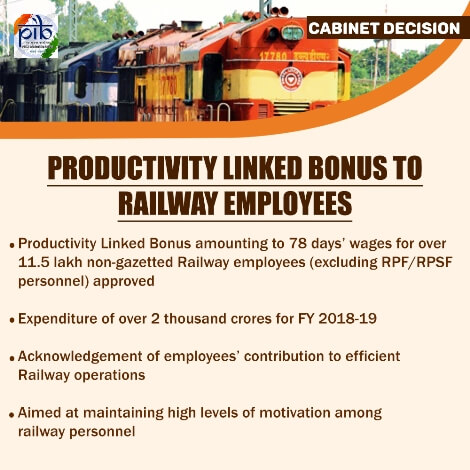
Cabinet approves Payment of PLB to railway employees for the FY 2018-19 
The Union Cabinet chaired by the Prime Minister Shri Narendra Modi has approved the payment of Productivity Linked Bonus (PLB) equivalent to 78 days wages to over 11.52 Lakh eligible non-gazetted railway employees (excluding RPF/RPSF personnel) for the Financial Year (FY) 2018-19, for maintaining industrial peace and motivation of railwaymen. This entails an expenditure of Rs. 2024.40 crores to the exchequer.
[post_ads]
This is the sixth consecutive year that the Government led by Mr Narendra Modi has maintained a bonus of 78 days wages. It has never lowered it.
railway-plb-2019-cabinet-decision
Benefits:
Payment of PLB equivalent to 78 days wages to eligible railway employees (excluding RPF/RPSF personnel) for the FY 2018-19 would result in motivating a large number of railway employees to improve the performance of the Railways and enhance the productivity levels further, besides maintaining industrial peace.
[post_ads_2]
PLB to all non-gazetted railway employees is an acknowledgement of their contribution to the efficient running of the Railways.
There being large number of railwaymen and their families, this acknowledgement will enhance the sense of inclusiveness and equity among them.
******

Non-Productivity Linked Bonus (Ad-hoc Bonus) to the Central Government Employees - Finmin Orders

Grant of Non-Productivity Linked Bonus (Ad-hoc Bonus) to the Central Government Employees for the year 2016-17

No.7/4/2014/E III (A)
Government of India
Ministry of Finance
Department of Expenditure
(E III-A Branch)

North Block, New Delhi
19th September 2017

OFFICE MEMORANDUM

Subject: Grant of Non-Productivity Linked Bonus (ad-hoc bonus) to Central Government Employees for the year 2016-17.

The undersigned is directed to convey the sanction of the President to the grant of Non-Productivity Linked Bonus (Ad-hoc Bonus) equivalent to 30 days emoluments for the accounting year 2016-17 to the Central Government
employees in Group ‘C’ and all non-gazetted employees in Group B, who are not covered by any Productivity Linked Bonus Scheme. The calculation ceiling for payment of ad-hoc Bonus under these orders shall be monthly emoluments of Rs. 7000/-, as revised w.e.f 01/04/2014 vide OM No.7/4/2014-E.III(A), dated 29th August, 2016. The payment of ad-hoc Bonus under these orders will also be admissible to the eligible employees of Central Para Military Forces and Armed Forces. The orders will be deemed to be extended to the employees of Union Territory Administration which follow the Central Government pattern of emoluments and are not covered by any other bonus or ex-gratia scheme.

2. The benefit will be admissible subject to the following terms and conditions:-

(l) Only those employees who were in service as on 31.3.2017 and have rendered at least six months of continuous service during the year 2016-17 will be eligible for payment under these orders. Pro-rata payment will be admissible
to the eligible employees for period of continuous service during the year from six months to a full year, the eligibility period being taken in terms of number of months of service (rounded off to the nearest number of months);

(ii) The quantum of Non-PLB (ad-hoc bonus) will be worked out on the basis of average emoluments/calculation ceiling whichever is lower. To calculate Non- PLB (Ad-hoc bonus) for one day, the average emoluments in a year will be divided by 30.4 (average number of days in a month). This will, thereafter, be multiplied by the number of days of bonus granted. To illustrate, taking the calculation ceiling of monthly emoluments of Rs. 7000 (where actual average emoluments exceed Rs. 7000), Non-PLB (Ad-hoc Bonus) for thirty days would work out to Rs. 7000×30/30.4=Rs.6907.89 (rounded off to Rs.6908/-).

(iii) The casual labour who have worked in offices following a 6 days week for at least 240 days for each year for 3 years or more (206 days in each year for 3 years or more in the case of offices observing 5 day week), will be eligible for this Non-PLB (Ad-hoc Bonus) Payment. The amount of Non-PLB (ad-hoc bonus) payable will be (Rs.1200×30/30.4 i,e.Rs.1184 21 (rounded off to Rs.1184/-). in cases where the actual emoluments fall below Rs.1200/- p.m., the amount will be calculated on actual monthly emoluments.

(iv) All payments under these orders will be rounded off to the nearest rupee.

(v) Various points regarding regulation of Ad-hoc I Non- PLB Bonus are given in the Annexure.

3. The expenditure on this account will be debitable to the respective Heads to which the pay and allowances of these employees are debited.

4. The expenditure to be incurred on account of Non-PLB (Ad-hoc Bonus) is to be met from within the sanctioned budget provision of concerned Ministries/Departments for the current year.

5. In so far as the persons serving in the Indian Audit and Accounts Department are concerned. these orders are issued in consultation with the Comptroller and Auditor General of India.

sd/-
(Amar Nath Singh)
Director


Authority: www.doe.gov.in

GDS Bonus @ Rs.7000- issue has been discussed in JCM (NC) Standing Committee meeting with the Govt.

GDS BONUS ENHANCEMENT TO Rs.7000-

This issue was discussed in the JCM Standing Committee meeting as a notified agenda. The official side informed that the file is still under process in the Finance Ministry and a decision is yet to be taken. Once the approval of the Finance Ministry is given the proposal is to be submitted to Cabinet for approval.

All affiliates and C-O-Cs are once again requested to extend full support and solidarity to the proposed Postal Strike on 9th & 10th November 2016, demanding bonus calculation ceiling limit enhancement to 7000/- for GDS and immediate payment of revised wages to casual labourers from 01.01.2006. Conduct solidarity demonstration in front of important Postal/RMS office on 9th & 10th November 2016.

MEETING ON GDS BONUS ISSUE WITH THE DEPARTMENT OF POSTS

A meeting on GDS bonus issue was convened by the Member (P) Shri A.K. Dash in his Chamber in the evening of 19.10.2016 with PJCA leaders Secretary Generals and Presidents of NFPE & FNPO attended the meeting.


Member (P) told that the case of enhancement of bonus ceiling is being pursued by the Secretary Post. He has met with Finance Secretary personally and requested to expedite the matter. Minister (C) has also written letter to Finance Minister to grant enhanced bonus to GDS. He assured that it will be approved by Finance Ministry soon.

Cabinet approves Productivity Linked Bonus ( 78 Days) to Railway Employees

The Union Cabinet chaired by the Prime Minister Shri Narendra Modi, has given its approval to pay Productivity Linked Bonus (PLB) equivalent to 78 dayswages to eligible non-gazetted railway employees (excluding RPF/RPSF personnel) for the financial year 2015-16. The approval entails a financial implication of approximately Rs.2090.96 crore.
Payment of PLB would result in motivating a large number of railway employees to improve the performance of the Railways and enhance the productivity levels further besides maintaining industrial peace.

The payment of this Bonus to eligible Railway Employees will be made before Dussehra/Puja holidays. 


Source:-PIB (Release ID :151187)

PLB to Railway staff will be disbursed before Pooja Festival


PLB to Railway staff will be disbursed before Pooja Festival

The Addl. Member Staff Railway Board, Shri Anand Mathur, has intimated today, i.e. 26.09.2016, AIRF leadership that, Railway Board’s orders for Restructuring of Technicians, to which an agreement was arrived at in Full Board Meeting held on 22.07.2016, will be issued in this week, and payment of 78-day PLB @ Rs.7000 p.m. will be made to all the Group `C’ and `D’ railwaymen well beforePooja Festival.

Source: AIRF

Govt to bring Bonus Act amendment bill

winter session to amend the Bonus Act, 1965, Prime Minister Narendra Modi told Parliament on Friday.  Replying to the two-day special debate to mark the Constitution Day and Dr BR Ambedkar’s 125th birth anniversary, Modi said: “We are going to bring an important bill in this House to amend Bonus Act. The Cabinet has already approved it. This is a very important bill for our workers. We are taking decisions and working for welfare of the labour class.” 

Bonus calculations :

The amendment bill seeks to enhance extent of coverage for payment of bonus from the existing wage limit of Rs 10,000 to Rs 21,000 per month as well as the calculation limit for payment of bonus from Rs 3,500 to Rs 7,000 per month.

The Union Cabinet had approved the amendment in the Payment of Bonus Act 1965 for the Industrial workers last month, making them eligible for the reward.

Source :  http://www.deccanherald.com

Enhancement of the ceiling of bonus - NC JCM Staff Side

Enhancement of the ceiling of bonus - NC JCM Staff Side


Shiva Gopal Mishra
Secretary

Ph.: 23382286
National Council (Staff Side) Joint Consultative Machinery
Central Government Employees
13-C, Ferozshah Road, New Delhi – 110001
E Mail : nc.jcm.np@gmail.com

No.NC/JCM/2015
Dated: October 9, 2015
All Constituent Organizations of National Council(JCM)(Staff Side)

Dear Comrades,

Sub: Enhancement of the ceiling of bonus

Ministry of Labour(Government of India) has sent a proposal to the Cabinet for enhancement of ceiling of bonus from Rs.3500 to Rs.7000 with a cap of maximum payment of Rs.20,000.

Though the Election Commissioner has cleared it, but it has not been included in the Cabinet Agenda for the reasons best known to government, but we are hopeful that, it may be finalized after Bihar elections.

Yours faithfully,
sd/-
(Shiva Gopal Mishra)
General Secretary

Source: NC JCM Staff Side

Govt mulls increasing eligibility limit of bonus from 10000 to 21000

Govt mulls increasing eligibility limit of bonus from 10000 to 21000

Central Government is considering to increase the eligibility limit of bonus from 10000 to 21000.

According to media source, the Central is going to give a green signal to the much awaited decision to raise eligibility limit of bonus from Rs.10000 to 21000. And the calculation ceiling also hike from Rs.3,500 to Rs.7,000

The payment of Bonus (Amendment) ordinance 2007 according to which section 12 of the payment of Bonus Act 1965 had been amended raising the ceiling for calculation purpose from salary of 2500/- P.M. to Rs.3500/-P.M. w.e.f. 01.04.2006. And also amended the Payment of Bonus Act, 1965 to raise the eligibility limit for payment of bonus from the salary or wage of Rs. 3500/- per month to Rs. 10000/- per month.


Central Government employees are regularly given Productivity Linked Bonus(PLB). Each department announces its bonus days in the month of September. But, since there was an upper limit, only small amounts were given as bonuses. CG Employees Federations all over the country were demanding that the limits should be raised.

Source: www.cgstaffportal.in

Expected Productivity Linked Bonus for Railway, Ordnance and Postal employees for the year 2010-11

Expected Productivity Linked Bonus for Railway, Ordnance and Postal employees
We compare the bonus details of last year and for this year, given in the table below for your information. Comparison of the large number of employees working in biggest ministry of Railways, Ordnance and Postal Departments are shown as below…

Ministry Bonus for 2009-10 Expected Bouns for 2010-11 Ceiling
Railway Department 73 Days 87 Days Rs.3500.00
Ordnance Department 40 Days 40 Days Rs.3500.00
Postal Department 60 Days 60 Days Rs.3500.00

NON-PRODUCTIVITY LINKED BONUS (AD-HOC BONUS) TO CENTRAL GOVERNMENT EMPLOYEES FOR THE YEAR 2010-11

Non PL (adhoc) Bonus to Central Govt Employees for 2010-11

Finance Ministry has published an Office Memorandum(No.7/24/2007/E.III(A) dated 13th September, 2011) in its website regarding that grant of Non-Productivity Linked Bonus (ad-hoc bonus) to Central Government Employees for the year 2010-11. Non-PLB for the year 2010-11 granted equivalent to 30 days emoluments to the Group ‘C’ and ‘D’ and all non-gazetted employees in Group ‘B’.
The calculation ceiling of Rs.3500 will remain unchanged.
The benefit will be admissible subject to the following terms and conditions as follows…
Only those employees who were in service on 31.3.2011 and have rendered at least six months of continous service during the year 2010-11.
To calculate bonus for one day, the average emoluments in a year will be divided by 30.4 (average number of days in a month). This will thereafter be multiplied by the number of days of bonus granted. For example, Non-PLB for thirty days would work out to Rs.3500 x 30 / 30.4 = Rs.3453.95 (rounded off to Rs.3454).
The casual labour who have worked in offices following a 6 days week for at lest 240 days for each year for 3 years or more (incase of 5 days in a week, 206 days in each year for 3 years or more).
To calculate the bonus for casual labur will be Rs.1200 x 30 / 30.4 = Rs.1184.21 (rounded off to Rs.1184).
All payments will be rounded off to the nearest rupee.
 
Coutesy : CGstaffnews.com