New Pension Scheme Demand To Scrap it
NEW PENSION SCHEME (NPS): The New Pension Scheme is made compulsory for Government employees was brought into effect 2004, this has effected them a lot, lot of agitations are being carried out on scrapping the New Pension Scheme, this agitations has forced many State Governments such as Karnataka, Kerala, Andhra Pradesh, Delhi State Governments to reconsider this New Pension Scheme and formed an expert committee to review this New Pension Scheme. This New Pension Scheme was not implemented by West Bengal State Government. In this angle an analysis is made all about New Pension Scheme and ways to scarp or modify the New Pension Scheme to benefit the Government employees at large is suggested.
Need for Pension : The Pension System thus started in India was finalized by the Indian Pension Act of 1871. It appears that the British Government had the conception of providing its pensioners increase in their pensions to neutralize the effect of inflation.
Pension is a reward for past service. It is undoubtedly a condition of service but not an incentive to attract new entrants, the Pension is paid for past satisfactory service rendered, and to avoid destitution in old age as well as a social welfare or socio-economic justice measure, the fact that the cost of living has shot up and correspondingly the possibility of savings has gone down and consequently the drop in wages on retirement.That pension is neither a bounty nor a matter of grace depending upon the sweet will of the employer and that it creates a vested right subject to 1972 rules which are statutory in character because they are enacted in exercise of powers conferred by the proviso to Art. 309 and clause (5) of Art. 148 of the Constitution; (ii) that the pension is not an ex-gratia payment but it is a payment for the past service rendered; and (iii) it is a social welfare measure rendering socio-economic justice to those who in the hey-day of their life ceaselessly toiled for the employer on an assurance that in their old age they would not be left in lurch.As on 01-01-2018 there were 51.96 lakh pensioners in the country, including from Central Civil Services, Railways, and Post, Defence and Defence civilians.
EVOLUTION OF NEW PENSION SCHEME (NPS) IN INDIA:
In 1991 Government of India as introduced diverse economic reforms to pull the country out of economic crisis and to accelerate the rate of growth. These reforms are often described as the New economic policy (NEP) or policy of LPG where L for liberalisation; P for privatisation; G for globalisation. The Congress Government under the Prime Ministership of Hon’ble Prime Minister Shri P. V. Narasimha Rao, the signed an agreement with the International Monetary Fund (IMF) to get the IMF loan in which the IMF had imposed various conditions to get the soft loan which includes pension reforms , which the Indian Government Congress Government had accepted it to reform in a 10 years period .
On the basis of the decision taken in the Eleventh Conference of State Finance Secretaries held in the Reserve Bank of India (RBI) during January 2003, a Group was constituted by the RBI in February 2003 to study the pension liabilities of the State Governments and make suitable recommendations.
The "Pension Fund" to be created under the proposed revised schemes should be kept completely outside the States' Consolidated Fund and the Public Account
The pension systems, both for Civil Servants and other citizens, as evolved over the years have begun to show signs of financial stress in many countries, including India. Since the pension benefits of Government employees are usually paid from the general revenue of the Governments, the steep rise in such liabilities adversely affect the fiscal soundness of the Government entities. In India too, the increasing pension liabilities of the Central and State Governments have emerged as a major area of concern, especially in the wake of fiscal deterioration in recent years. About 20% of the state Government funds are spent on pension.
During the Hon'ble Prime Minister Shri Atal Bihari Vajpayee of NDA was in power from 1998 to 2004 which implemented this agreement of IMF on pension reforms . The NDA Government constituted two committees namely B.K.Bhattacharya committee headed by Shri B.K.Bhattacharya, Former Chief Secretary, Government of Karnataka as chairman and under the Chairmanship of Shri Biju Patnaik, Chief Minister of Orissa , both these committees recommended introduction of New Pension Scheme (NPS) & Hon'ble Prime Minister Shri Manmohan Singh of Congress (UPA) was in power from 2004 to 2014 continued to accept these pension reforms.
The New Pension Scheme (NPS) was announced on December 22, 2003 by the NDA Government, for all new government employees excepting those in the Armed Forces. This brand new system replaces the defined benefit system of pension and this includes GPF. Contributory pension scheme is for entrants who joined after 1st January 2004.
While the NPS is mandatory for the Central government employees, it has potentially a much wider reach. As of March 2007, 19 states which have decided to introduce similar schemes, mandating newly recruited civil servants to mandatorily join the NPS‐type scheme.
The NPS started with the decision of the Government of India to stop defined benefit pensions for all its employees who joined after 1 January 2004. While the scheme was initially designed for government employees only, it was opened up for all citizens of India in 2009. Over 15 lakhs Government employees are currently registered in NPS scheme.
The Department of Economic Affairs (DEA) at the Ministry of Finance, notified a new pensions regulator in August 2003, before the NPS commenced operations in January 2004. The PFRDA bill was presented in 2005, and was finally passed in Parliament in 2013.
Let us analyse why Government is adopting the pension reforms:
| Sl. no | Indian Government View | Employees view |
|---|
| 1 | The ratio of retirees to workers is on continuous rise and further by 2030 the 25% of the population (200 million pensioners) will be above 60 years of age. | The large number of employees are effected by the New Pension reforms, hence Government should keep it in mind the interest of the large chunk of employees |
| 2 | The Pension system shall put enormous financial pressure on the Government and take away funds meant for social cause spending, this will cause a drain on the state of economy. | About 80 % of employees are Group "C" workers, the pension amount is ultimately spent by them for their daily needs and money flows into the market and economy will not be effected , secondly Government is a model employer and it has social responsibility towards its employees. |
After a decade of existence, there is need to examine the existing NPS and compare the performance of this system to the goals with which it was created.
*One of the key bottlenecks has been the lack of a sound regulatory framework, put in place by an empowered and independent regulator. The PFRDA Bill that had been pending since 2002 was finally passed in 2013. This enables the formal institutionalisation of the PFRDA as the regulator of the NPS. The PFRDA can now take on the task of both the relatively short term agenda of closing the gap between the current NPS and the original design.
*Central government employees can invest in these assets only through their Tier II account which get higher returns on longer period.
- After the enactment of the Pension Fund Regulatory and Development Act, 2013, it is not the exclusive liability of the government to pay the pension."
The Ministry of Finance will oversee and supervise the Pension Funds through a new and independent Pension Fund Regulatory and Development Authority.”
WHAT IS THE NATIONAL PENSION SCHEME?
Each Government employee contributes 10 % of his salary (Basic Pay + DA + DP) to the pension account , which is then matched by a Government contribution of an equal amount .
National Pension Scheme or New Pension scheme is a pension plan offered by the government. Investment in this scheme is via debt and equity market. The invested amount is locked until retirement. At retirement age, you can withdraw 60% of the maturity amount while the balance40% must be invested in annuity. The maturity amount is taxable. The NPS is regulated by the PFRDA and fund management is by designated fund managers from the private and public sector. NPS has the lowest charges.
From our salaries and daily allowance, 10 per cent is cut towards pension and an equal amount is given by the government. This amount is invested into the share markets under the new scheme.
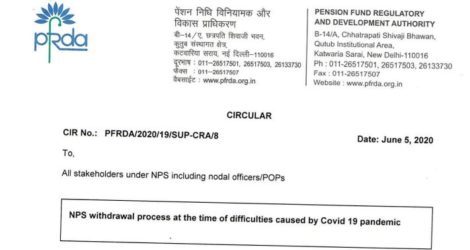
An NPS subscriber can withdraw 25% of his contribution to the corpus for emergencies before retirement. Instead of withdrawing the entire amount at retirement, you can withdraw Rs 25,000, or 25% of your contribution, earlier, without any tax incidence. The remaining Rs 1.75 lakh is withdrawn on retirement.
New Pension Scheme extension of benefits of Retirement Gratuity and Death Gratuity to the Central Government employees covered by New Defined Contribution Pension System (National Pension System)-regarding. All these condition would be equally applicable for grant of gratuity to employees covered under New Pension Scheme.
An individual can claim tax deduction of upto 10 percent of the salary contributed towards NPS under Section 80 C. For those contributing through the corporate scheme, an employee can claim tax deduction on contribution made by the employer, not exceeding 10 percent of his basic salary plus dearness allowance (if any) Under Section 80 CCD (2). This is above the overall limit of Rs.1 lakh offered under Section 80C.
How New Pension Scheme (NPS) is affecting the Government employees.
The New Pension Scheme is highly disadvantageous to the Government employees under the present situation the pension amount is invested into the share markets under the new scheme. If the markets are doing well, the employees will get a good pension if the share market fails no pension is available to them. Under the old system, employees would get a fixed amount as pension that was 50 per cent of their last basic salary. When the salary was hiked, the pension amount too would be revised. Under the present NPS system, there is no security as pensions depend on market conditions. Secondly the NPS is highly disadvantageous if the length of the Government service is less if a employee serves for 20 years, he draws a pension of about Rs 3,000/- to Rs 5,000/ only. If he completes 33 years of service he draws about Rs 12,000/- to Rs 15,000/- compared to Rs 15,000/- to Rs 20,000/- in the old pension system, this new pension system needs a deep study and its minimum pension should be at least 50% of the last pay drawn. It is upto the Government how and where the money is invested, but a minimum guarantee of 50% of the last pay drawn should be assured by the Government to the employee.
Under New Pension Scheme is in reality much steeper than what the quantum of pension would indicate the differential treatment for those retiring under Old Pension scheme and New Pension Scheme, would be according differential treatment to pensioners who form a class irrespective of the type of retirement and, therefore, would be violate of Art. 14. It was also contended that classification based on fortuitous circumstance of retirement in old or New Pension Scheme, fixing of which is not shown to be related to any rational principle, would be equally violate of Art. 14.
Pension Scheme around the Globe : The USA, Canada, United Kingdom, China , Germany etc. Governments have a scheme of a Defined Benefit (DB) pension is where you receive a specific amount of pay out that is guaranteed by employer, regardless of how their pension investment performs. Your defined benefit amount depends on how much is paid into the plan and your years of service with that employer.
CONCLUSION:The Indian Government should also have a similar Defined Benefit (DB) pension scheme like other major countries in the world have, as many state Governments are re thinking on the New Pension Scheme, hence this New Pension Scheme should be remodelled to suit the Government employees. The Government should take up more social responsibilities of protecting its employees.
We request the government to reintroduce the old pension system. For this a greater movement should take place amongst the New Pension Scheme employees forcing Central Government to rethink the new pension policy adopted after 2004.
P.S.Prasad
Working President
COC Karnataka
Source: http://karnatakacoc.blogspot.com/